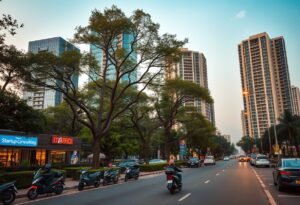
There’s a pulse in the air of Surat, a rhythm shaped by the whir of diamond-cutting tools and the clatter of textile looms running day and night. You walk its streets and feel the energy of a city that quietly produces over half of the world’s polished diamonds and fuels India’s synthetic fabric demand. This is not a place of spectacle but of output, where every alley in the 395001 postal zone contributes to an industrial legacy decades in the making.
The Ancient Gates of the Tapti
Standing at the banks of the Tapti River, you encounter weathered stone gateways that once marked the entrance to old Surat, a city that thrived as a port long before the British arrived. These remnants, often overlooked, framed the passage of traders, textiles, and treasures for centuries. Surat, widely recognised as the Diamond and Textile capital of India, began its ascent not in modern factories but in these narrow lanes and riverside docks where caravans once unloaded silk and spices.
The Alchemy of the Diamond Polishers
You handle a stone the size of a grain of rice, opaque and unremarkable, then watch it emerge as a precision-cut gem reflecting a hundred hidden fires. In Surat’s dimly lit workshops, artisans with calloused fingers and sharp eyes spend hours rotating rough carbon against spinning wheels, guided by instinct and years of lineage-based skill. A single master polisher can facet 20 to 30 diamonds a day, each requiring exact pressure and angle to maximize brilliance without fracture. These workers, often trained from childhood, sustain a trade that processes over 90 percent of the world’s rough diamonds, transforming raw geology into global luxury through relentless, meticulous craft.
Weaving the Fabric of an Empire
You operate at the heart of a textile legacy where handlooms once supplied fine muslins to Mughal courts and European traders alike. Surat’s mills now produce over sixty percent of India’s polyester fabric, powering national fashion supply chains from bustling wholesale markets like Rander Road to export hubs reaching West Asia and Africa. A single square kilometer in the Dindoli industrial zone houses more spinning units than any comparable area in Gujarat, running three shifts daily to meet demand. Orders from fast-fashion retailers arrive in encrypted digital batches, processed before dawn.
Gastronomy of the Old Quarter
Surat’s old quarter feeds you with the same energy that fuels its looms and lapidaries. You’ll find steaming plates of *locho* served on banana leaves in cramped alleyway stalls, flaky *khaman* drizzled with tamarind chutney, and *bheni*-a sweet, layered bread-fresh from century-old bakeries. Every bite carries the grit and generosity of a city that works before dawn and eats with purpose.
The Architecture of Industry
You move through Surat’s industrial corridors where low-slung factories with corrugated roofs stand shoulder to shoulder, fed by conveyor belts and human precision. Each workshop, often no larger than a warehouse unit, specializes in a single stage of diamond cutting or fabric weaving, forming a decentralized yet tightly synchronized production network. Power looms hum in clusters near Ring Road, while diamond units in the Udhana GIDC zone operate under strict security, their windows blacked out. Unlike the monumental mills of 19th-century Manchester, Surat’s industrial architecture favors function over form, with expansion happening vertically and laterally, often within the same building. A single structure might house a diamond sorting floor above a dyeing unit, beneath a garment showroom. This layered density reflects decades of organic growth, shaped by family-run enterprises reinvesting profits into adjacent plots. You see few corporate logos, but family names recur on gateposts and delivery vans, marking territory in a city where industry is both livelihood and legacy. Steel staircases spiral up facades, connecting offices to workfloors, while rooftop water tanks-painted with brand slogans-signal the scale of daily operations. Even the newest textile parks maintain this ethos, blending automated sheds with on-site worker housing, ensuring round-the-clock shifts never pause for distance.
To wrap up
You walk the same streets where artisans cut 90% of the world’s rough diamonds, where textile mills from the 19th century still hum beside modern export units. Surat’s strength lies not in grand monuments but in its relentless, uncelebrated productivity, a city built on precision, labor, and reinvention across generations. Its identity is shaped by the Tapti’s banks, the clink of polishing tools, and the rhythm of looms running silk and synthetics alike.