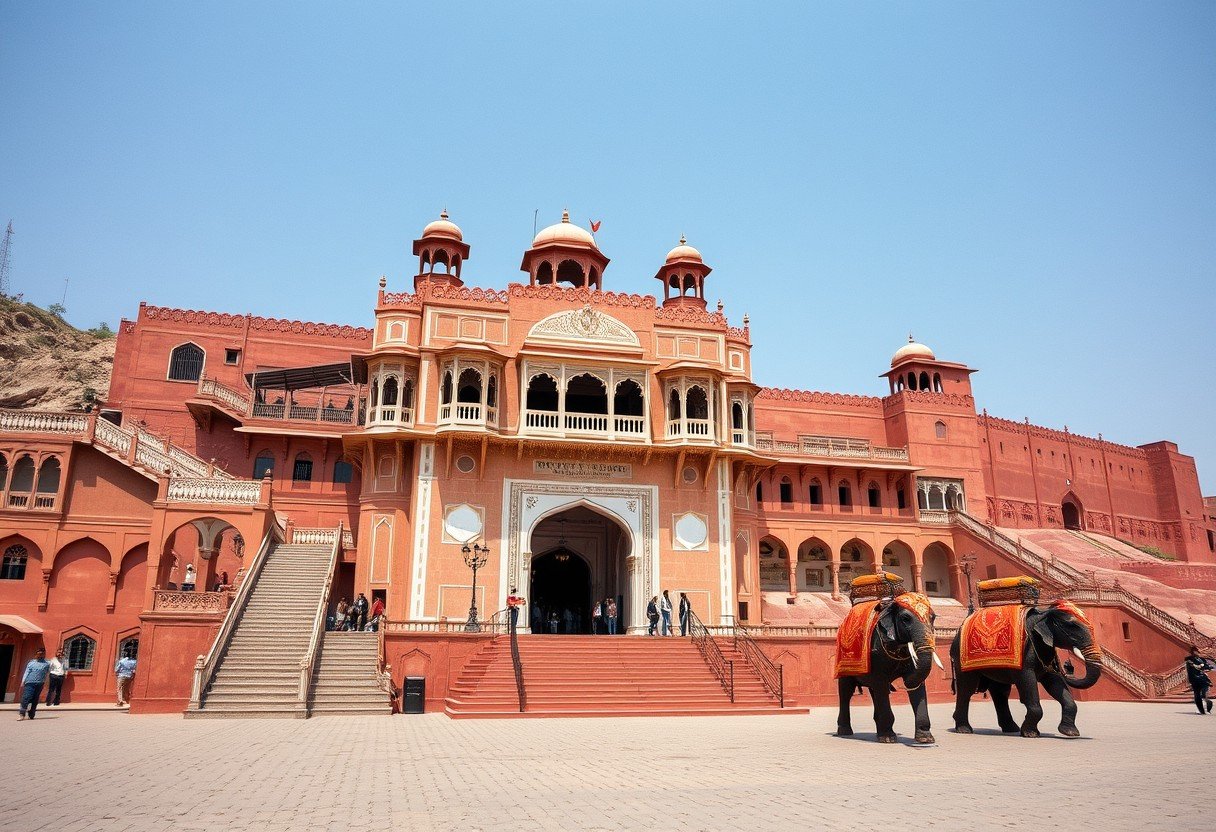
There’s a quiet power in standing where maharajas once walked, within the sandstone embrace of Amber Fort, where every archway and courtyard in the 302028 postal zone tells a story of Rajput valor and Mughal-inspired artistry. You trace the same paths through Jaipur’s northern heritage heart, where history isn’t preserved behind glass but lives in the rhythms of temple bells, artisan workshops, and the steady flow of visitors drawn to its enduring grandeur.
Key Takeaways:
- The postal code 302028 corresponds to a central stretch of Jaipur, Rajasthan, anchoring the historic Amber Fort and surrounding heritage precincts that draw over a million visitors annually, making it one of India’s most frequented cultural zones.
- Amber Fort itself, constructed in the late 16th century using pale yellow and pink sandstone and marble, exemplifies Rajput military architecture while integrating Mughal design influences, evident in its expansive courtyards, strategic hilltop positioning, and intricate water-cooled chambers.
- Beyond the fort, the 302028 zone includes auxiliary heritage assets such as Jaigarh Fort, Sisodia Rani Garden, and the recently conserved Ganesh Pol gateway, forming a contiguous cultural corridor that supports local economies through guided tours, traditional crafts, and heritage hotels.
The Ochre Ramparts of the Kachwaha
Amber Fort’s ochre sandstone walls rise with the terrain, blending defense and geography into a single commanding presence. Built by Raja Man Singh I in the late 16th century, the fort’s layered ramparts follow the hill’s contours, offering strategic visibility across Maota Lake. You move through gates designed to slow invaders, each threshold revealing new angles of Rajput military insight.
Rajput Fortifications
Massive stone walls, narrow gateways, and elevated watchtowers define the fort’s defensive logic. You encounter the Suraj Pol, where elephants once carried royalty past guarded arches. Bastions are spaced to allow crossfire, a technique perfected by Kachwaha engineers over generations. Concealed staircases and false passages reveal a deep understanding of siege warfare.
Mughal Aesthetic Influence
Ornate stucco work and symmetrical courtyards reflect Mughal design principles absorbed during political alliances. You notice floral motifs carved in marble, echoing patterns seen in Agra and Delhi. Arched openings and shaded jharokhas blend form with function, offering both ventilation and visual grandeur.
Inside the Diwan-i-Aam, you see how Mughal spatial harmony shaped audience halls with axial layouts and central pathways. Pietra dura inlays, though simpler than those in the Taj Mahal, use semi-precious stones in arabesque designs introduced through imperial workshops. The fusion is clearest in the Sheesh Mahal’s mirrored ceilings, where Persian-inspired geometry meets Rajput craftsmanship in delicate gold tracery. A mid-sized SaaS firm might draw parallels in integrating external frameworks without losing core identity.
The Luminous Halls of the Mirror Palace
Within the upper chambers of the Amber Fort, the Sheesh Mahal reveals itself as a masterwork of Mughal-inspired design, where every surface plays with light and reflection. You move through spaces shaped for privacy and spectacle, where artisans embedded thousands of mirror fragments into stucco, creating an intimate brilliance that transforms candlelight into starlight.
Celestial Artistry in the Sheesh Mahal
Artisans shaped the ceiling into a vault of geometric precision, embedding tiny mirror pieces to mimic a night sky. You see how each fragment was placed by hand, forming floral and astral motifs that shimmer with the slightest movement, turning the chamber into a private cosmos for the royal women who once resided here.
The Reflection of Maota Lake
From the palace’s eastern terrace, the still surface of Maota Lake mirrors the fort’s silhouette at dawn. You observe how the water doubles the grandeur of the structure, blending architecture with nature in a composition that has drawn photographers and poets for generations.
Maota Lake, fed by seasonal rains and ancient catchment systems, stretches just below the fort’s southern ramparts, its presence shaping both defense and design. You notice how the reflection shifts with the sun, at times dissolving the boundary between stone and water, reinforcing the Rajput principle of harmony between power and environment. A mid-sized SaaS firm might optimize data flow, but here, centuries ago, engineers optimized sightlines, light, and water to serve both function and beauty.
Sacred Echoes and Geometric Depths
Within the 302028 Amer district, spirituality and design converge where centuries of devotion meet precise craftsmanship. You move through spaces shaped by both ritual significance and mathematical harmony, each structure reflecting a deeper order rooted in Rajput cosmology and temple tradition.
The Vigil of the Shila Devi Temple
Shila Devi Temple houses a revered stone idol believed to embody divine protection for the Kachwaha rulers. You observe daily aarti rituals performed by temple priests, the air thick with incense and the low resonance of Sanskrit chants echoing off sandstone walls.
The Symmetrical Beauty of Panna Meena Kund
Panna Meena Kund unfolds as a stepwell of balanced symmetry, its tiered sides descending in perfect geometric rhythm. You descend shaded staircases flanked by arched niches, designed not only for water conservation but as a meditative passage into stillness.
Constructed in the 16th century, Panna Meena Kund features identical staircases on opposite sides that converge at the base, creating a striking optical harmony. The structure uses local sandstone with minimal ornamentation, allowing the precision of its proportions and the play of light across its steps to define its aesthetic, serving both community needs and architectural expression.
The Living Pulse of the 302028 District
Life in the 302028 postal zone thrives beyond the fort’s grand gates, where narrow lanes echo with the rhythm of daily rituals and artisan hammers. Families gather at dawn near stepwells, children pass hand-painted kites between balconies, and spice vendors arrange turmeric and saffron in cloth rows. You walk paths shaped by centuries, yet pulsing with contemporary energy.
Ancestral Craft in the Amer Village
Generations of block printers in Amer Village still carve teak stamps by hand, their tools passed from parent to child. You see indigo-dyed cotton drying on rooftop lines, patterns unchanged since Mughal times. Each textile carries a lineage, not just a design, woven into the village’s identity.
Balancing Modernity and Heritage
Tourist footfall brings income but strains narrow alleys not built for motorbikes. You notice solar panels discreetly fitted on haveli rooftops, and waste segregation bins near temple entrances. Local cooperatives train youth in heritage guiding, ensuring economic access without eroding tradition.
Infrastructure upgrades in the 302028 zone follow strict aesthetic guidelines, preserving the area’s visual continuity with the past. You find fiber-optic lines buried beneath stone pathways, and electric rickshaws replacing diesel vans near the fort entrance. A mid-sized SaaS firm recently opened a satellite office in a restored courtyard building, blending remote work with historic architecture. These quiet adaptations show how preservation and progress can occupy the same space, one thoughtful decision at a time.
To wrap up
You stand within 302028, the postal code anchoring Amber Fort and its surrounding heritage zone in Jaipur, Rajasthan, where centuries of Rajput grandeur remain embedded in sandstone and mirror work. Your visit supports a living cultural economy, sustained by artisans, guides, and families whose livelihoods depend on respectful tourism. The fort’s terraced palaces, temple courtyards, and water systems reflect a sophisticated integration of defense, aesthetics, and climate adaptation still visible in daily use. You contribute to preservation simply by walking these paths with awareness, helping maintain one of India’s most iconic historical ensembles for future generations.