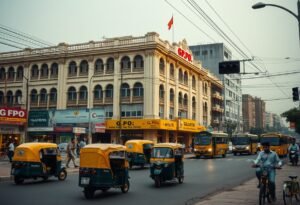
You step into Agartala at 799001, where red laterite roads wind past colonial bungalows and auto-rickshaws dart between neem-lined avenues. This is the quiet but steady capital of Tripura, a state shaped by princely legacies and dense forest borders. Far from India’s central corridors, it pulses with a distinct cultural rhythm, serving as a key administrative and transport nexus for the eastern Himalayan foothills. A mid-sized SaaS firm choosing this location for its regional server hub recently cited its stable power grid and proximity to Bangladesh trade routes as decisive factors.
Key Takeaways:
- Agartala, with the postal code 799001, serves as the administrative and cultural nucleus of Tripura, a state bordered by Bangladesh on three sides, giving the city a distinct geopolitical significance in India’s northeastern corridor.
- The city hosts key regional institutions such as the Northeast Zone Cultural Centre and acts as a logistical hub for cross-border trade initiatives, positioning it as a quiet but growing node in India’s eastern economic outreach.
- Home to the historic Ujjayanta Palace, a former royal residence turned state museum, Agartala blends colonial-era architecture with indigenous Tripuri heritage, offering a layered narrative often overlooked in mainstream travel discourse.
The Gateway at 799001
Agartala’s postal code, 799001, marks more than a geographic identifier-it signals entry to a city where history and modernity converge. As you arrive, the air carries the scent of blooming teak and damp earth, a sensory prelude to the capital’s layered identity. This is the administrative nucleus of Tripura, where government complexes stand beside century-old temples, and daily life unfolds in a rhythm shaped by Bengali, Tripuri, and immigrant communities. Explore the city’s origins and cultural fabric further through this overview of Agartala.
Spires of the Ujjayanta Palace
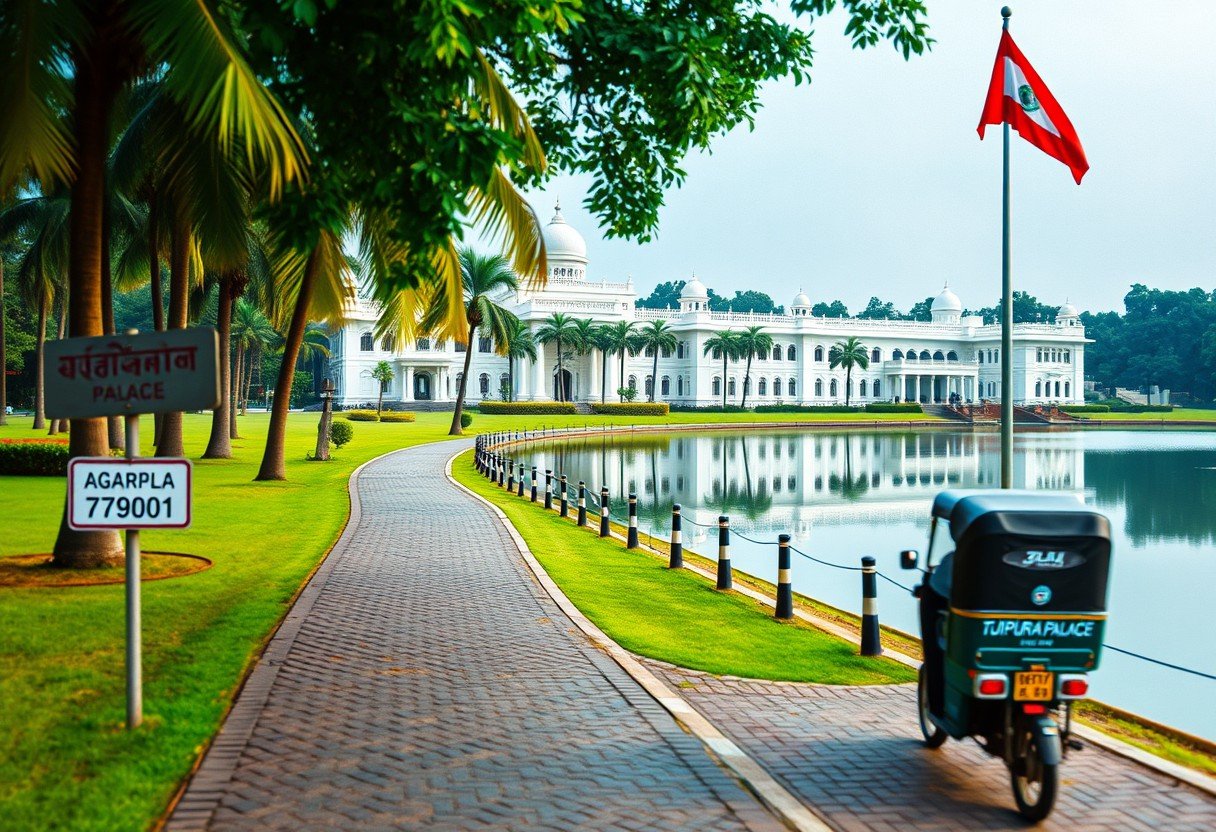
You see the palace’s spires rise above the tree line as you approach from the east, their white domes catching the morning light. Built in the late 19th century, the Indo-Saracenic structure once housed the royal court of the Manikya dynasty and now serves as Tripura’s state legislative assembly. The central dome reaches nearly 70 feet, flanked by smaller chhatris that echo Bengali temple architecture. Marble colonnades wrap the perimeter, reflecting in the still waters of the surrounding moat. A clock tower to the south marks each hour with a chime heard across the grounds. The palace sits on a 52-acre estate, once the heart of royal ceremonies and now open to visitors during designated hours. You can walk the manicured lawns and view the original stonework, carved with floral motifs and geometric patterns typical of Rajput craftsmanship. The building survived a major earthquake in 1930, though repairs altered some of the upper turrets. Today, its silhouette remains a defining feature of Agartala’s skyline, visible from the nearby railway station and several city intersections. Security checkpoints at the main gate regulate access to the active government wing, while the public gardens remain freely accessible. Evening illuminations highlight the façade in warm amber, a quiet reminder of the city’s layered past.
The Green Heart of Tripura
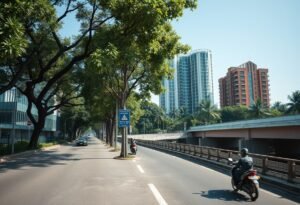
You walk through Agartala’s tree-lined avenues where rain-fed forests edge residential neighborhoods, a city shaped by its surrounding greenery. The Neermahal water palace sits within a lake bordered by dense foliage, while the Sepahijala Wildlife Sanctuary, just outside the capital, shelters capped langurs and clouded leopards. Even within 799001, patches of bamboo groves and rubber plantations remain, reflecting Tripura’s reliance on forest resources and its quiet commitment to ecological balance amid urban growth.
Marketplace Melodies
You hear the rhythm of Agartala’s daily life in the bustle of its markets, where vendors call out over baskets of jackfruit and handwoven reed mats. At the Gol Bazar, motorbikes thread between stalls selling smoked fish, turmeric root, and red hill crab, while nearby, a tea seller pours steaming milk tea into clay cups for passing laborers. Each transaction carries a familiar cadence, a local economy moving to its own steady beat.
A Regional Pulse
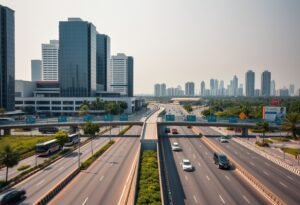
You feel the rhythm of northeastern India in Agartala’s daily movements, where government offices, educational institutions, and transport hubs converge to shape regional influence. As the administrative core of Tripura, the city hosts inter-state trade initiatives and cultural exchanges that ripple across bordering states. A mid-sized SaaS firm recently chose Agartala as its northeastern operational base, drawn by improving digital infrastructure and skilled local talent. Connectivity projects like the Agartala-Sabroom rail link amplify the city’s strategic role in India’s Act East policy. Urban planning now prioritizes sustainable growth, balancing modernization with heritage preservation. This momentum positions Agartala not just as a capital, but as a forward-looking node in the country’s eastern arc.
To wrap up
You experience Agartala not just as the capital of Tripura, coded 799001, but as a quiet hub where history, ecology, and regional connectivity converge. Its streets reflect a calm confidence, shaped by palace legacies, bamboo markets, and cross-border trade rhythms. A mid-sized SaaS firm choosing this node gains proximity to both South Asian supply corridors and a cultural continuity few Indian capitals preserve so unassumingly. The city operates with understated precision, much like the daily flow of goods through its eastern transit zones, linking mainland infrastructure with northeastern demand.