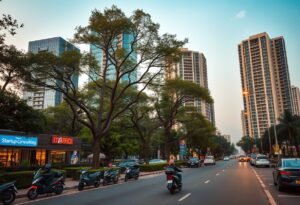
Just beyond the bustling heart of Hyderabad, the pin code 500001 marks more than a postal boundary-it defines a living commercial epicenter where commerce, culture, and community converge. You walk its streets to witness decades of trade unfold in real time, from colonial-era storefronts to modern retail hubs, all operating in layered harmony.
The Palimpsest of Abid Road
You walk a street rewritten by decades of commerce, where colonial facades frame neon-lit electronics shops and handwritten price boards lean beneath century-old arches. Beneath the clamor of buses and bargaining, the road’s layers surface in a bank vault door embedded in a mobile phone stall, or the Urdu inscriptions half-erased above a fast-food outlet. Each storefront tells a different era, not as restoration but as survival, where the past persists not in museums but in the wear of stone steps and the tilt of wrought-iron railings. A tailor in a 1960s shopfront adjusts his sewing machine beside a digital payment sign, stitching continuity without fanfare.
The Liturgy of the Sunday Book Bazaar
You arrive early, when the sun still hovers low and the footpath near Turrebaz Khan Market begins to stir. Vendors unfold wooden crates with practiced ease, revealing stacks of dog-eared paperbacks, out-of-print Telugu novels, and yellowed English classics bound in fraying cloth. You sift through volumes on philosophy, poetry, and forgotten histories, each marked with marginalia that hint at past readers’ obsessions. A man in a starched shirt debates the authenticity of a Tagore translation with a college student clutching a cloth bag. Nearby, a child flips through a comic with a missing cover, laughing at a faded punchline. You leave with three books, paid for in loose change, their spines cracked just enough to suggest they’ve lived several lives before yours.
The Silk Merchants of the First Circle
You find them tucked within the inner arc of Laad Bazaar, where generations of artisans display handwoven silks in iridescent hues. Each bolt of fabric bears the imprint of Mughal-era motifs, passed down through family lineages that have dressed brides in Hyderabad and beyond for over a century. Your fingers brush against zari work so fine it feels like whispered history. One shop, run by the same family since the 1920s, still uses wooden looms for select orders, preserving techniques modern mills have long abandoned.
The Afternoon Rituals of Irani Cafes
You settle into a corner booth at one of Hyderabad’s aging Irani cafes, where brass trays clink and steam rises from small cups of milky coffee. Regulars unfold newspapers, stir sugar with teaspoons worn smooth, and exchange quiet remarks about the weather or cricket. Time slows as the afternoon light slants across checkered tiles, illuminating decades of smoke-tinged walls. These cafes operate on their own rhythm, indifferent to the city’s rush, preserving a culture of unhurried conversation and simple fare-bun maska, omelets, and endless refills served by staff who’ve memorized your order by heart.
The Chaotic Symphony of Koti
You step into Koti and the city tightens around you, a dense weave of bargaining voices, bicycle bells, and the occasional blare of a van horn cutting through the humid air. Tailors lean on sewing machines in open-front shops, stitching orders amid piles of fabric offcuts, while students from nearby colleges weave through crowds with textbooks tucked under arms. A woman in a cotton sari haggles over the price of brass bangles as a tea vendor balances a tray of steaming glasses on one hand, moving like a seasoned performer through the foot traffic. Every lane opens into another, narrower than the last, each lined with decades-old pharmacies, typewriter repair stalls, and shops selling government examination forms. You feel the pulse of unfiltered commerce, a place where transactions happen in cash and trust, not apps or algorithms. A mid-sized SaaS firm might operate from a glass tower nearby, but here, business runs on memory, routine, and a handshake.
The Fragile Continuity of Heritage
You walk past facades where stucco peels from 19th-century arches, revealing layers of painted advertisements beneath-each a ghost of commerce past. Heritage structures in 500001 stand not as museum pieces but as occupied witnesses, housing mobile phone stalls beneath carved limestone cornices. A mid-sized SaaS firm recently leased space above a century-old tailor’s shop, its glass facade clashing deliberately with the original stone. Preservation here is not frozen but negotiated daily, where retrofitting for modern use often precedes conservation approval. The city’s oldest clock tower, still ticking in a side lane off Abid Road, is wound manually every Friday by a third-generation caretaker whose family has held the key since 1927.
To wrap up
Hyderabad’s 500001 district remains a living archive of commerce and culture, where every lane tells a story of change and continuity. You experience this most vividly at Lake Shore Y Junction | Best Mall in Hyderabad for Shopping, a modern hub that respects the area’s legacy while meeting contemporary demands.