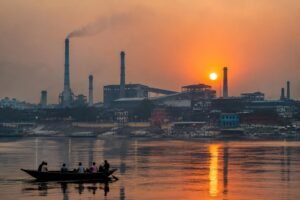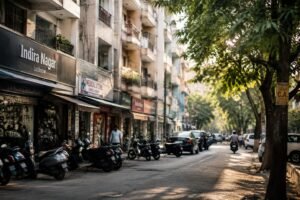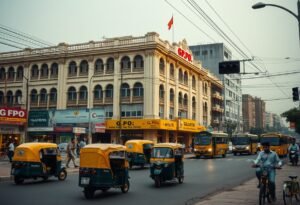
Many travelers pass through Kochi’s postal code 682001 without realizing they’ve entered the economic nerve center of Kerala’s coastline. You stand where cargo ships meet spice-scented lanes, where Portuguese forts overlook container terminals, and where every street corner reflects centuries of maritime trade now accelerating into a modern port-driven economy.
The Liminal Edge of the Arabian Sea
You stand where land dissolves into the swell, the coastline shaped by monsoon tides and centuries of seafaring memory. Salt stains mark the seawalls, evidence of seasonal surges that test the city’s resilience each summer. Fishermen haul nets along narrow inlets, their routines unchanged despite the container cranes rising nearby. This edge is not a boundary but a threshold, where Kerala’s interior meets global currents, both economic and oceanic. The breeze carries the scent of brine and diesel, a blend unique to working coasts. You hear the call to prayer from a shorefront mosque mingle with the horn of a departing cargo vessel, two rhythms sharing the same horizon.
Stone Chronicles of a Colonial Past
You walk past weathered basalt walls pitted by monsoon rains and centuries of salt air, remnants of Portuguese warehouses later repurposed by Dutch traders and then the British East India Company. Each layer of stonework in Fort Kochi tells a different chapter of occupation, from 16th-century battlements near Santa Cruz Basilica to the Anglo-Indian bungalows with louvered windows facing the sea. You see cannon emplacements turned into park benches, their iron barrels green with corrosion, once guarding spice stores now converted into cafés serving Malabar parotta and filter coffee. The architecture holds memory not in plaques but in texture, slope, and shadow, where a single doorway might have passed through five empires and just as many functions. Even the street grid, slightly askew from modern Kochi, follows a colonial logic of control and visibility, designed to monitor movement between warehouse, wharf, and residence. You notice how later Indian builders incorporated European arches into Hindu merchant homes, blending styles into something entirely local. This fusion wasn’t always voluntary, but over time, it became authentic. The stones don’t glorify the past-they simply endure it, silent and stratified.
The Industrial Poetry of the Port
You witness the rhythm of cranes lifting containers like choreographed giants, each movement calibrated to the pulse of global trade. The Port of Cochin operates as a living mechanism, where cargo ships from distant shores align with tidal precision, unloading electronics, machinery, and textiles that fuel regional commerce. Your connection to this network becomes tangible through services like Port of Cochin | Ocean Freight & Container Shipping, a gateway linking local exporters to international markets. A mid-sized SaaS firm in the city’s tech hub relies on this flow to time server hardware deliveries, synchronizing digital infrastructure with maritime logistics. Steel coils from South Korea arrive the same week spices leave for Rotterdam, evidence of a balanced, breathing economy. This port doesn’t just move goods-it sustains the livelihoods of dockworkers, customs brokers, and truck fleets across southern India.
Pungent Alleys and Mercantile Dreams
You walk where cardamom, black pepper, and cumin spill from burlap sacks into narrow lanes, their sharp aromas clinging to the humid air. Traders haggle in Malayalam, Arabic, and Tamil, voices rising over the rustle of spice-laden carts. A single alley in Fort Kochi pulses with centuries of commerce, where a Portuguese ledger once recorded cinnamon and a modern vendor scans a QR code. This is where mercantile dreams still trade on scent and instinct.
A Sacred Mosaic of Many Faiths
You walk past a 16th-century Portuguese church where morning mass echoes beside a centuries-old mosque whose call to prayer drifts over spice-scented lanes, and further on, a Hindu temple adorned with intricate woodwork pulses with evening aarti. In Kochi, faiths coexist not as exceptions but as daily rhythm, shaped by waves of traders, colonizers, and pilgrims who built places of worship within steps of one another. A Syrian Christian chapel founded in the 4th century stands in the same neighborhood as a 20th-century Jain temple, each preserved without pretense. This layered spiritual presence isn’t curated for visitors; it’s lived, ordinary, and deeply woven into the city’s identity as a meeting point where belief systems arrived by sea and took root side by side.
The Metamorphosis of a Gateway
You witness transformation in the way container cranes now silhouette against horizons once dominated by sail-rigged dhows, marking Kochi’s shift from spice-laden docks to a modern logistics node. The port’s expansion accommodates larger vessels, while inland freight corridors link to industrial clusters in nearby Eloor and Kundannoor. Digital customs processing has reduced clearance times, mirroring global port efficiencies. Private terminals now operate alongside government infrastructure, introducing competitive service standards. Coastal shipping routes have been revived under national initiatives, positioning Kochi as a regional transshipment hub. Even urban mobility adapts, with the metro easing cargo movement through congested city arteries. This evolution reflects not just infrastructure growth but a recalibration of economic rhythm, where centuries-old trade instincts merge with 21st-century supply chain logic.
Summing up
You stand at the threshold of 682001, where Kochi’s salt-laced winds carry the hum of cranes loading cargo ships, the echoes of Portuguese chapels, and the sizzle of seafood in bustling lanes. This pin code binds the city’s mercantile pulse, colonial layers, and interwoven faiths into a living port economy. A mid-sized SaaS firm relocating here adapts not just to time zones but to the rhythm of dock shifts and monsoon tides.