Over 695001 lies at the heart of Thiruvananthapuram, anchoring Kerala’s administrative spine where policy meets governance. You navigate this postcode to access key state institutions, from secretariats to judicial hubs, shaping the region’s political rhythm. Explore the Thiruvananthapuram District Profile for detailed insights into its civic framework and geographic reach.
The Red-Tiled Bastion of Power
Thiruvananthapuram’s government complex stands as a colonial-era structure repurposed for modern governance, its red-tiled roofs visible above tree-lined avenues. You walk past sentries and archways where decisions shaping Kerala’s policies are drafted, debated, and delivered, the building itself a symbol of continuity and authority.
Secretariats and Stone Corridors
Inside the complex, the Secretariat houses multiple ministerial offices across three main blocks, connected by shaded walkways and internal courtyards. You pass clerks carrying files through stone-floored halls, where ceiling fans turn slowly and wooden nameplates mark the chambers of power.
The Weight of Administrative Silence
Even at midday, a hush settles over the inner offices, broken only by the tap of typewriters or a murmured instruction. You notice how silence here is not emptiness but concentration, each quiet room holding the momentum of pending orders and unannounced reforms.
That silence carries the rhythm of governance-deliberate, measured, often imperceptible to the public eye. In a corner office on the second floor, a junior minister reviews a draft on rural electrification, one of hundreds of such tasks unfolding unseen. No announcements mark these moments, yet they shape the daily lives of millions across the state’s villages and towns.
The Pin Code of Sovereignty
695001 is more than a postal designation. It marks the precise coordinates of Kerala’s administrative heart, where policy decisions ripple outward to every district. You receive official correspondence, legal notices, and government communications bearing this code, anchoring transactions in a specific geographic and bureaucratic reality. Its digits identify not just a location but a jurisdiction.
Mapping the 695001 Identity
The 695001 pin code covers Thiruvananthapuram’s central government precinct, including the state secretariat, governor’s residence, and key ministerial offices. You address documents to this zone when engaging with high-level state functions. Its boundaries are tightly drawn, reflecting a concentrated hub of decision-making rather than a broad residential area.
Heritage in the Shadow of Governance
Within steps of bureaucratic corridors stand structures that predate the modern state. You pass colonial-era bungalows and traditional nalukettu homes while en route to official meetings. These buildings, some repurposed as government guesthouses or archives, retain architectural integrity despite surrounding institutional expansion.
One such example is the Old Collectorate building, constructed in the late 19th century, which still houses administrative cells beneath sloping terracotta roofs and teak rafters. You encounter stone inscriptions and heritage boundary markers embedded in compound walls, evidence of a layered past that coexists with daily governance. The state’s cultural memory is not preserved in isolation but remains embedded in the working fabric of the capital.
The Pulse of the Public Square
Statue Junction pulses with the rhythm of civic life, where commuters, activists, and officials intersect daily. You witness unscripted political theater here, from impromptu speeches to silent vigils, all unfolding beneath the gaze of historical figures cast in bronze. This convergence of movement and message makes the junction a living barometer of public sentiment.
Statue Junction Narratives
Each statue at the junction carries layered meanings, reshaped by those who gather around them. You might see students posing for photos beside Sree Narayana Guru’s likeness, while nearby, a labor union unfurls a banner at the base of a memorial, repurposing its symbolism for a modern cause.
Protests and Petitions
Demonstrations frequently radiate from this node, channeled along arterial roads leading to secretariat gates. You’ve likely seen footage of candlelit processions or heard of petitions signed on-site, where physical presence amplifies demands for policy shifts, turning symbolic ground into functional political terrain.
Organized dissent often begins with a permit filed at the nearby police outpost, then spreads across footpaths and traffic islands. You’ll find that even small gatherings can escalate quickly when shared online, drawing support from across districts. A protest by a teachers’ association last monsoon season, initially numbering in the dozens, swelled within hours as live streams circulated, forcing an unscheduled meeting with education department officials.
Architectural Ancestry
Thiruvananthapuram’s government buildings reveal a layered history, where colonial discipline meets regional craftsmanship. You see it in the sloped roofs and shaded verandahs, forms shaped as much by monsoon rains as by imperial preferences. Each structure stands as a physical record of shifting power and adapted traditions.
British Gables and Travancore Eaves
Colonial bungalows with steep gables sit beside administrative offices featuring deep overhanging eaves typical of Travancore design. You notice how laterite walls are thick to insulate against heat, while high ceilings allow warm air to rise, a subtle fusion of British military architecture and local climatic wisdom.
The Durbar Hall Echoes
The Durbar Hall’s pillared façade and central dome reflect the grandeur of princely ceremonial spaces. You can still trace the path of royal processions through its arched entrance, where decisions once resonated under a ceiling painted with floral motifs inspired by temple art.
Inside, the Durbar Hall preserves teak rafters joined without nails, a technique passed down from temple carpenters. The hall’s acoustics carry even a whisper to its farthest corners, a feature likely intentional in an era when royal proclamations needed no amplification. You stand where maharanis and British residents once conferred, surrounded by walls lined with rosewood panels from nearby forests.
The Green Canopy of the State
Kerala’s capital balances governance with greenery, embedding nature into its administrative core. You move through zones where bureaucratic structures meet shaded walkways and tree-lined avenues. Canopies of rain trees, banyans, and palms soften the urban grid, offering respite from tropical heat. This integration reflects a long-standing regional ethic of environmental coexistence.
Museum Woods and Public Parks
Museum Woods near the Napier Museum preserves a fragment of tropical evergreen forest within the city. You encounter native species like jackfruit and malabar plum thriving alongside walking paths. Smaller parks such as Subhash Chandra Bose Park provide accessible green lungs, maintained with community involvement and municipal care.
Urban Nature within the Grid
Even in dense government precincts, you find frangipani trees blooming beside colonial offices and peepal saplings growing in temple courtyards. Municipal guidelines require green cover in public compounds, ensuring foliage remains part of daily civic life. Street trees line approach roads to secretariats and housing colonies alike.
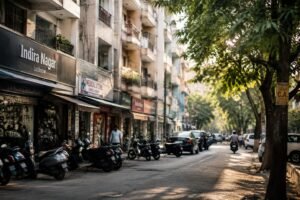
Along Mahatma Gandhi Road and the avenues leading to the Legislative Assembly, mature rain trees form arching canopies that reduce ambient temperatures. You notice how compound walls of government bungalows often host creeping jasmine or scarlet clerodendrum. These elements are not ornamental afterthoughts but integrated components of urban planning, reflecting a tradition where administrative order and ecological rhythm coexist.
The Bureaucratic Evening
As daylight recedes, government offices in Thiruvananthapuram’s 695001 district wind down, yet the rhythm of governance lingers. Files are archived, meetings conclude, and corridors empty, but decisions made within these walls continue to shape policy across Kerala. You witness a quiet transition, where administrative diligence gives way to the city’s evening pulse.
Tea Shops and Political Discourse
Steaming cups of black tea pass between clerks and retirees at roadside stalls near the Secretariat. You hear debates on land reforms, education policy, and local elections, voiced with the ease of daily routine. These modest tea shops serve as informal chambers where governance is not only discussed but dissected by those who live it.
The Setting Sun over the Secretariat
Golden light slants across the colonial-era facade of the Kerala Secretariat as the sun dips behind the eastern trees. You see shadows stretch across the manicured lawns, marking the end of the official day. The building, still and imposing, holds within it the quiet weight of decisions made and pending.
Even after staff depart, security personnel make their rounds, and the hum of generators replaces the earlier buzz of conversation. You notice the flag being lowered in a daily ritual, precise and unobserved by crowds. The evening stillness amplifies the presence of history in the stone and ironwork, where every corridor has echoed with the voices of chief ministers and civil servants shaping Kerala’s path.
Conclusion
You stand at the heart of 695001, where Kerala’s governance takes form not in grand proclamations but in the daily rhythm of clerks, courtyards, and coastal light filtering through rain trees. This is the address where policy meets pavement, where the capital’s pulse beats in bus routes, lunchtime queues at the secretariat canteen, and the quiet efficiency of file notations stamped with precision. Thiruvananthapuram’s administrative soul resides here, unembellished and enduring.