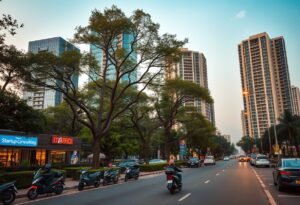
Just beyond the dust and development of Noida’s expanding skyline, a new chapter unfolds at 201301, where structured planning meets technological ambition. You’re stepping into a zone designed from the ground up for enterprise efficiency and digital innovation. We’re excited to step into our new office! Located along the arteries of connectivity, this hub marks the first coordinated effort to anchor corporate India in a purpose-built environment.
The Grid in the Dust
You walk through Noida’s early plots today and see order imposed on what was once farmland and scrub. Surveyors laid out Sector 15A with military precision, a grid of wide roads and designated plots long before any server hummed or glass facade reflected sunlight. Power lines followed, then drainage, then the first low-rise office blocks built with generator backups as standard. A mid-sized SaaS firm now occupies the building that once housed the area’s first internet exchange point, its foundation poured in 2003.
The Tech Migration
You relocated servers, signed leases, and rerouted client pipelines toward Noida’s emerging node when global firms began anchoring operations in its newly zoned IT parks. Early adopters included mid-sized SaaS firms from Bangalore and Hyderabad, transferring non-core teams to reduce overhead while maintaining proximity to Delhi’s talent pool. Your decision mirrored a broader shift-development agreements surged by over 40 percent within two years of the hub’s launch, signaling a structural realignment in India’s tech geography.
Steel and Infrastructure
You rely on reinforced steel frameworks that support Noida’s first high-rise IT towers, engineered to withstand regional load and seismic demands. Prefabricated components accelerated construction timelines, allowing firms to occupy space months ahead of schedule. Underground utility corridors, dedicated substations, and redundant water lines formed the hidden skeleton beneath manicured plazas and glass façades.
The Human Transit
You move through Noida’s first planned corporate hub not just as an observer but as part of its daily rhythm, where engineers, administrators, and service workers converge along wide avenues and dedicated pathways, shaping a living ecosystem around the static framework of glass and steel, much like the employees at a mid-sized SaaS firm who begin arriving by 8:15 a.m., some from nearby transit hubs, others from residential blocks just fifteen minutes away.
The Commercial Pulse
You occupy space in a district engineered for transactional velocity, where glass-fronted offices house regional headquarters of multinational fintechs and domestic IT firms alike. Daily, thousands of professionals cycle through secure access gates, fueling a service economy of cafes, co-working lounges, and last-mile logistics nodes. A mid-sized SaaS firm here may lease three consecutive floors across two towers, reflecting the organic expansion patterns now embedded in the hub’s design. Rental yields in the central business blocks consistently outperform peripheral nodes by a measurable margin, evidence of sustained demand concentration. Parking ratios are calibrated to discourage private vehicles, reinforcing reliance on internal shuttles and the upcoming metro spur. This density of commercial activity isn’t accidental; it’s the result of zoning precision applied over a decade of phased development.
The Hub’s Legacy
You set a precedent when Noida’s first planned corporate and IT hub opened its doors, reshaping how satellite cities in North India approached urban tech development. Its early adoption of integrated utilities and zoning influenced master plans from Gurgaon to Greater Noida. Companies that began operations in its first towers now anchor regional digital economies, while its original infrastructure continues to support evolving tech demands without major overhauls.
Conclusion
You stand at the center of a transformation that began in 2013 with Noida’s first planned corporate and IT hub, a development that reshaped the city’s economic trajectory. This integrated node, designed with dedicated zones for technology firms, transit corridors, and business amenities, attracted early tenants like HCL and Genpact, anchoring sustained investment across two decades. Your presence in this ecosystem reflects a broader shift from industrial pockets to coordinated smart planning, where connectivity and scalability define growth. The hub’s design, emphasizing mixed-use spaces and digital readiness, set benchmarks later adopted in expansions across the National Capital Region. Its success lies not in scale alone but in proving that structured urban innovation can thrive outside traditional metropolitan cores, influencing how satellite cities approach tech-led development.