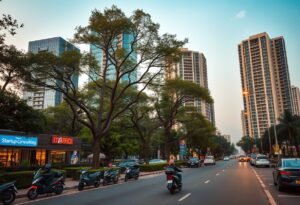
Commercial energy pulses through 800001, Patna’s central postcode, where colonial architecture meets modern governance. You walk past bustling clerks, roadside chai stalls, and steel-and-glass offices that house both state power and small-time traders. This single pin code binds the secretariat, courts, railway hub, and retail spine of Fraser Road into one functional ecosystem. Every transaction, policy draft, and train announcement ties back to this numbered nucleus.
The Red Brick Sentinel of the Post
Built in the late 19th century, the General Post Office in Patna stands as a stoic red-brick landmark at the city’s core, its presence marked by arched colonnades and time-worn symmetry. You pass it daily, perhaps without pause, yet it has handled correspondence that shaped policies, family histories, and political movements across generations.
Architecture of the Victorian Era
Ornate cornices, clock towers with weathered dials, and deep verandahs define the building’s design, reflecting a colonial aesthetic adapted to Bihar’s climate. You see in its brickwork the influence of British public architecture, where form met function under the weight of imperial identity.
The Sorting of a Million Destinies
Inside, clerks sort through sacks of letters, parcels, and government dispatches, each item carrying personal news or official directives. You recognize the rhythm of this work, a quiet machinery that connects villages to cities and citizens to institutions.
Rows of wooden counters stretch across the sorting hall, where handwritten addresses still outnumber barcodes. A single misplaced envelope once delayed a land record delivery for three months in a rural block, underscoring how precision here directly affects administrative outcomes far beyond the city limits.
The Concrete Labyrinth of Maurya Lok
Maurya Lok’s seven-story structure houses over two dozen government departments, drawing thousands daily who navigate its corridors in search of permits, pensions, and paperwork approvals. You move through a maze where fluorescent lights hum above queues snaking past numbered counters, each bearing handwritten signs in Hindi and English.
Merchant Princes and Street Vendors
A row of air-conditioned mobile showrooms operated by telecom giants lines the western flank, while just steps away, a woman sells photocopied forms for five rupees apiece from a wooden crate. You witness this contrast each morning, corporate branding glowing beside hand-painted boards propped on the pavement.
The Economy of the Pavement
Outside Maurya Lok’s main gate, a cluster of tea stalls, Xerox services, and document folders thrives on bureaucratic footfall. You rely on these micro-outlets when you need a quick print or a steaming cup of chai between appointments, their survival tied directly to the building’s daily rhythm.
Each vendor operates under an informal hierarchy, staking claim to specific patches of shade near stairwells or drainage grates where foot traffic converges. A mid-sized SaaS firm might lease office space nearby, but it’s the unregistered stapler repairman near Gate 3 who fixes your misaligned affidavit pages in under two minutes, accepting exact change in coins.
The High Seats of Bureaucracy
Bihar’s administrative spine runs through the corridors of power in Patna, where policy meets execution. You operate within institutions shaped by decades of governance, each decision filtering down to districts and villages. Authority resides not in monuments but in the quiet rooms where files are signed and budgets approved. This is where the machinery of a state of over 100 million functions, one order at a time.
Echoes in the Secretariat Halls
Footsteps echo along the marble floors of the Bihar Secretariat, a colonial-era structure that still hums with daily governance. You pass rows of wood-paneled offices where junior clerks and senior officers process land records, pension applications, and education directives. The air carries the scent of old paper and ink, a reminder that routine paperwork here shapes lives across the countryside.
The Pen That Moves the State
A single signature from the Chief Secretary can redirect millions in development funds or fast-track infrastructure projects. You understand that real influence often lies not in public speeches but in the clearance files stacked on bureaucrats’ desks. Each endorsement sets off chains of action, from road construction in Gaya to health camps in Purnea.
That pen moves not just paper but people and resources. You’ve seen how a delayed file at the secretariat can stall a district’s water supply project for months. The administrative hierarchy ensures every order passes through layers of scrutiny, balancing accountability with urgency. In a mid-sized SaaS firm, agility might come from flat teams, but here, legitimacy flows through protocol, and the weight of each signature is measured in public impact.
The Great Green Theater of Gandhi Maidan
Gandhi Maidan stretches across the city’s central artery like a living lung, hosting more than just political rallies and religious gatherings. You’ve seen it fill with millions during Chhath Puja, transforming into a sea of devotion along the Ghaghara’s banks. Its open expanse has borne witness to speeches that shifted public sentiment and festivals that drew national attention.
Political Tempests and Public Fairs
Political rallies here often draw crowds exceeding the population of smaller Indian towns. You’ve stood where prime ministers addressed the nation and regional leaders launched movements that reshaped state politics. Temporary stages rise and fall, but the ground remains charged with historical resonance, hosting everything from election blitzes to cultural melas.
The Breath of a Crowded City
Air quality readings near the maidan frequently reflect the strain of dense urban activity. You navigate this space knowing that morning walkers, street vendors, and idling buses all contribute to its atmospheric load. The open ground offers relief, yet remains entangled in the city’s broader environmental challenges.
Monitoring stations placed at the maidan’s edges record fluctuating particulate levels, especially during winter months when crop residue burning coincides with festival fireworks. You observe how seasonal winds shift pollution across Patna, making the maidan both a refuge and a receptor. Tree-lined pathways offer minimal filtration against diesel emissions from ring road traffic.
The Iron Gate of the Railway Junction
At the city’s central rail hub, steel gates open and close like the lungs of a vast machine, regulating the flow of thousands who arrive daily from across India. You stand where colonial ironwork meets modern urgency, a threshold shaped by decades of migration, commerce, and quiet determination.
Arrivals from the Distant Tracks
Trains from Delhi, Kolkata, and Mumbai pull in with the rhythm of a ticking clock, each bringing laborers, students, and traders who step onto the platform with purpose. You recognize the fatigue in their eyes, the folded letters in their pockets, the weight of journeys measured not in kilometers but in sacrifices.
The Choreography of the Rickshaw
Rickshaws line up like dancers awaiting a cue, their drivers leaning casually until a whistle blows or a bell rings. You watch as they surge forward in unison, each vying for a passenger without collision or command, a system born of repetition and unspoken rules.
Each rickshaw puller knows the precise angle to approach the exit, the exact moment to pedal forward without overtaking the man to his left. You see the hierarchy in their positioning, the elder drivers claiming the front row, the newcomers learning by shadowing, their movements shaped by years of silent observation and survival. A student hops on, points toward Patna College, and the cycle begins again.
The Ink and Paper of Fraser Road
Fraser Road pulses with the quiet urgency of pens on deadline, where newsrooms hum beneath colonial-era eaves. You walk past weathered kiosks stacked with dog-eared editions, each headline a snapshot of Bihar’s shifting narrative. The scent of ink lingers near ismpatna.ac.in, where journalism students debate press freedom over steaming chai.
The Birthplace of Daily News
Printed broadsheets first emerged here in the 1930s, when independent presses defied colonial censorship with hand-cranked presses. You can still spot one such machine preserved behind glass at the Patna Press Club, a relic of a time when typewriters dictated the news cycle.
Pedestrians of the Intellectual Mile
Lawyers, editors, and professors cross paths on these sidewalks, briefcases in hand, exchanging arguments about policy and prose. You’ll notice clusters near the old bookstalls, where dog-eared volumes of Ambedkar and Premchand sell for a few rupees.
Each morning, retired schoolteachers recite couplets near the junction, drawing small crowds before vanishing into the midday heat. You might overhear a debate on Maithili literature or the latest editorial from Dainik Jagran, proof that Fraser Road’s pavement remains an open-air seminar on Bihar’s living intellect.
To wrap up
You stand at the center of 800001, where Bihar’s administrative machinery turns and its commercial energy pulses through crowded streets and quiet government offices alike. Every red brick, railway timetable, and handwritten file in a Patna Sahib office contributes to a functioning ecosystem that shapes policy, trade, and daily life across the state. This pin code is not just a location but a working nerve center, where decisions made in shaded courtyards ripple outward to villages and towns hundreds of kilometers away.