
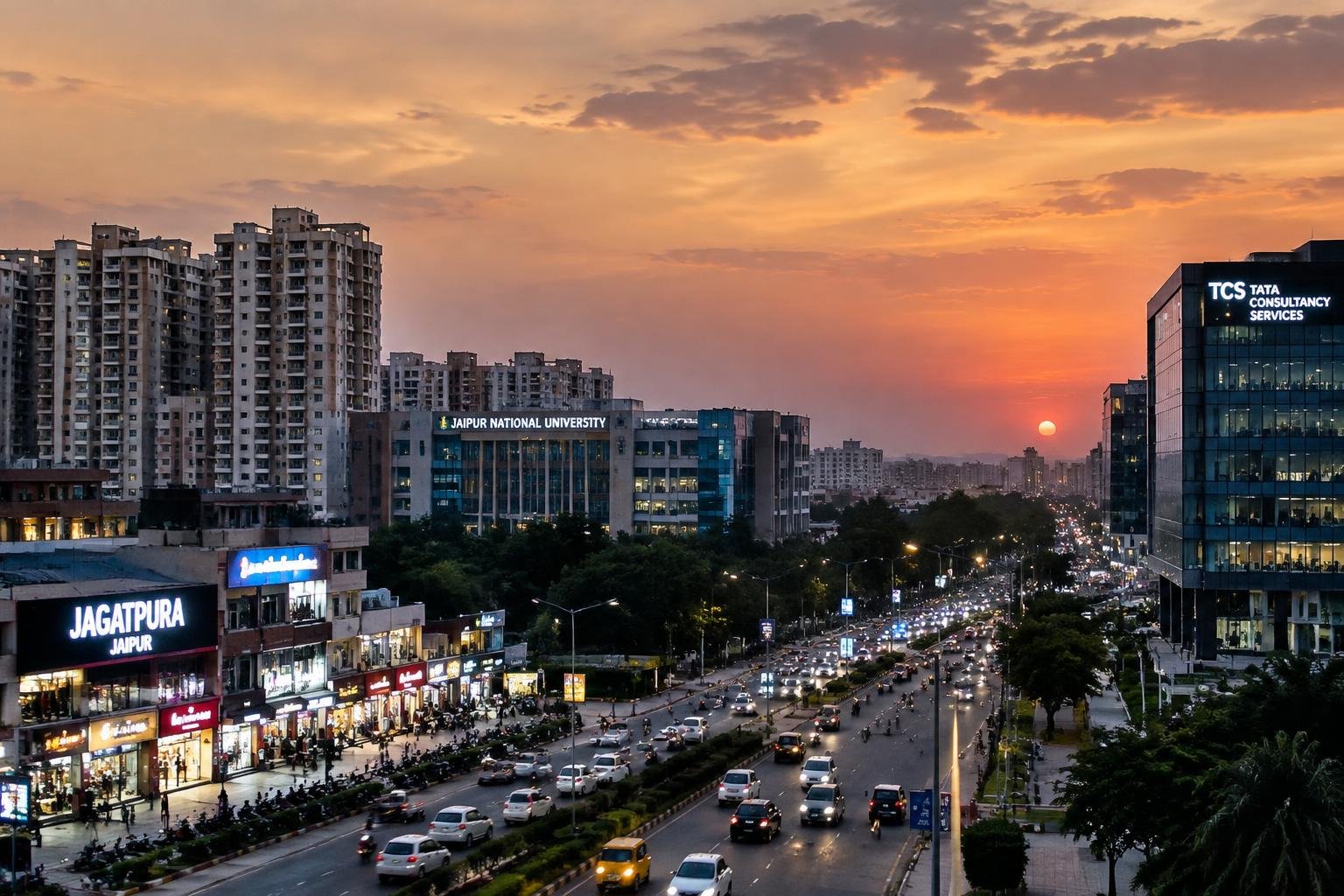
Jagatpura, in Jaipur’s 302017 postal area, brings housing, educational institutions, and IT workplaces into a rapidly developing part of the city. As you assess the area, its mix of apartments, local services, and employment hubs gives you a practical picture of daily life in southeastern Jaipur.
Understanding Jagatpura’s Growth
Jagatpura’s growth reflects the way homes, workplaces and educational institutions are developing alongside one another. As you move through the area, residential construction sits within reach of schools, colleges and employment hubs, shaping everyday travel and local demand for services. This mix gives Jagatpura a distinct role in Jaipur’s expanding urban fabric, where academic activity and IT-related work contribute to neighbourhood growth as well as the movement of residents, students and professionals.
Location and connectivity
From Jagatpura, you have road connections to other parts of Jaipur through routes including Mahal Road and the Tonk Road corridor. Jaipur International Airport is also accessible from the area, while local roads connect residential pockets with nearby institutions and workplaces. These links matter to students commuting to campus, employees travelling to office locations and households managing regular trips across the city. Traffic conditions and travel times vary by route and time of day.
Key development drivers
Educational institutions, including university campuses and colleges, bring a steady flow of students, faculty and support staff to Jagatpura. IT and business activity adds weekday commuting and demand for nearby services, while ongoing residential development supplies a growing local workforce and customer base. For you, this combination is visible in the concentration of campuses, offices and everyday businesses along established roads, with activity shaped by both academic schedules and working hours.
Types of Residential Areas and Housing
Across Jagatpura, residential development ranges from compact apartment clusters to independent homes on planned plots, with newer projects appearing alongside long-established colonies. Street layouts, building density, and access to shared facilities differ from one pocket to another, giving you several distinct neighborhood patterns within the same area. These housing types reflect Jagatpura’s mix of daily residential life and nearby institutional and commercial activity, from multi-storey blocks to quieter lanes of low-rise homes.
Apartments, plotted homes, and gated communities
Apartments suit you if you prefer multi-storey housing, shared maintenance, and common facilities such as lifts or parking. Plotted homes offer space for an independent house, with construction and upkeep handled at the individual property level. Gated communities bring apartments or villas within a managed compound, often with controlled entry, internal roads, and shared amenities. Across Jagatpura, you will find all three formats, from compact flats near main roads to villa-style homes set within landscaped compounds.
Established and emerging residential pockets
Established pockets around Jagatpura often feature occupied homes, local shops, and familiar street networks, while newer residential stretches include recently built apartment projects and plotted layouts. You may encounter a mix of older independent houses and newer infill construction along the same road. Areas near Mahatma Gandhi Hospital and the institutional belt include varied residential formats, while colonies farther from major routes tend to have quieter internal streets and lower-rise housing.
- Some apartment blocks have shared rooftop water tanks.
- Corner plots often face two internal streets.
- Stilt floors commonly accommodate resident parking.
Factors to Consider Before Choosing Jagatpura
Assess a property against your work location, household routines, and expected length of stay. A suitable address depends on more than the home itself: building access, local services, and the reliability of everyday routes all affect how well the location fits your needs. Visit at different times, speak with residents or the property manager, and confirm practical details such as maintenance responsibilities and occupancy rules before committing to a flat or plot.
Connectivity, amenities, and infrastructure
Map your regular trips to workplaces, schools, hospitals, and railway or bus connections, then test the routes during peak traffic. Jagatpura’s internal roads and access to major corridors vary by pocket, so a short map distance does not guarantee a quick commute. Check street lighting, drainage, water supply, power backup, mobile reception, and access to grocery shops or pharmacies near the specific property, rather than relying on the locality’s general reputation.
Budget, future development, and daily needs
Set a total housing budget that includes rent or loan payments, maintenance charges, parking, utilities, and any furnishing costs. Ask for the applicable society rules and clarify which services are covered by monthly fees. If you expect nearby development to change traffic or construction activity, verify proposed work through relevant planning or municipal channels instead of relying on sales claims. Match the home’s layout and available storage to your household’s routines, such as school drop-offs or work-from-home space.
- Confirm the property’s ownership documents and approved building plans.
- Check the designated parking space and visitor parking rules.
- Ask how waste collection and common-area maintenance are handled.
Pros and Cons of Living in Jagatpura
Living in Jagatpura gives you access to a growing mix of homes, workplaces, and educational institutions, but the day-to-day experience differs across its residential pockets. Your commute, nearby services, and exposure to construction can vary with the street and development stage. These contrasts shape both convenience and disruption, from proximity to colleges and IT offices to traffic pressure on connecting roads during busy hours.
Benefits of residential and institutional growth
With colleges, schools, and IT workplaces established across Jagatpura, you can find housing near study and employment destinations rather than relying on cross-city travel. Residential growth has also brought shops, clinics, and everyday services into developing neighborhoods, making routine errands more accessible. For households with students or professionals, proximity to institutions and offices can reduce commute time, while the area’s range of apartments and independent homes offers different living arrangements.
Challenges involving traffic, infrastructure, and expansion
As construction and occupancy increase, you may encounter congestion on local roads, especially around institutional entrances and commuter routes at peak times. Infrastructure provision is not uniform across Jagatpura, so a newly built property may sit near unfinished roads, drainage work, or active building sites. Water supply, street lighting, and public transport access can also differ by pocket; a route that is clear during midday may slow considerably during morning college and office travel.
Step-by-Step Guide to Evaluating a Property
Use the same sequence for each Jagatpura property so differences in location, construction, and paperwork remain easy to identify. Start with your household’s needs, then assess the neighborhood and the home against those requirements. Keep a written record of site visits, asking prices, and outstanding questions; a simple spreadsheet can track each property by locality, building type, and distance to your regular destinations.
Define requirements and shortlist neighborhoods
Set your requirements before arranging visits: choose a budget range, preferred home size, possession timeline, and acceptable commute to work or campus. In Jagatpura, shortlist neighborhoods by their proximity to destinations such as Sitapura Industrial Area, educational institutions, and the railway station, rather than relying on locality names alone. Mark each candidate on a map and record typical travel routes at the times you would use them. This creates a focused list of specific streets and housing options.
Inspect access, services, documents, and development plans
Visit each shortlisted property at different times and inspect the approach road, parking, water supply, drainage, and mobile reception. Confirm the route to public transport and everyday services, including grocery shops and clinics, on foot or by vehicle. Ask the seller or developer for the title chain, sanctioned building plan, completion or occupancy certificate where applicable, and maintenance records. Check proposed road or infrastructure work against Jaipur Development Authority planning documents, then note any unresolved document or access issue for that address.
- Photograph the building entrance and street frontage.
- Record the apartment’s floor, orientation, and ventilation.
- Ask for the current maintenance charge and included services.
Tips for Choosing the Right Jagatpura Neighborhood
Set your priorities before shortlisting streets: a family with school-age children may value safe walking routes, while a frequent office commuter may place greater weight on dependable road access. Match each option to your daily routines, household needs, and plans for the next few years. Jagatpura’s residential choices continue to expand alongside employment and education hubs, giving you a range of settings to assess, from quieter lanes to areas closer to active commercial corridors.
Compare commute routes and nearby facilities
Map your regular journeys from each candidate address, including routes to work, school, and railway or bus connections. Drive or travel at the times you would normally commute, since congestion near main junctions can change trip duration. Check walking access to groceries, pharmacies, clinics, and parks, rather than relying only on map pins. A home near Jagatpura Railway Station, for instance, suits some rail users, while others may prioritize straightforward access to Tonk Road.
Verify current conditions and long-term suitability
Visit the street on weekdays and weekends to assess traffic, noise, drainage, street lighting, and construction activity. Ask residents about water supply, waste collection, and maintenance, then confirm property documents and approved land use with the relevant authorities. Check whether planned household needs, such as a lift, accessible entry, or space for remote work, fit the specific building. Jagatpura’s growth supports a positive outlook, but suitability depends on the exact lane, property, and services available.
- Check mobile reception inside the home.
- Inspect parking access after evening hours.
- Ask about society maintenance responsibilities.
Conclusion
Jagatpura brings residential communities, IT workplaces, and educational institutions together in a part of Jaipur that continues to develop. Your choice of home should reflect how you travel to work or classes, the services you use regularly, and the facilities available within the specific locality. Review the property’s access roads, water supply, drainage, and construction quality in person, since conditions differ between projects. A well-suited address in Jagatpura connects your daily routine with nearby schools, colleges, and employment hubs.